Mormonism (LDS)Exposed
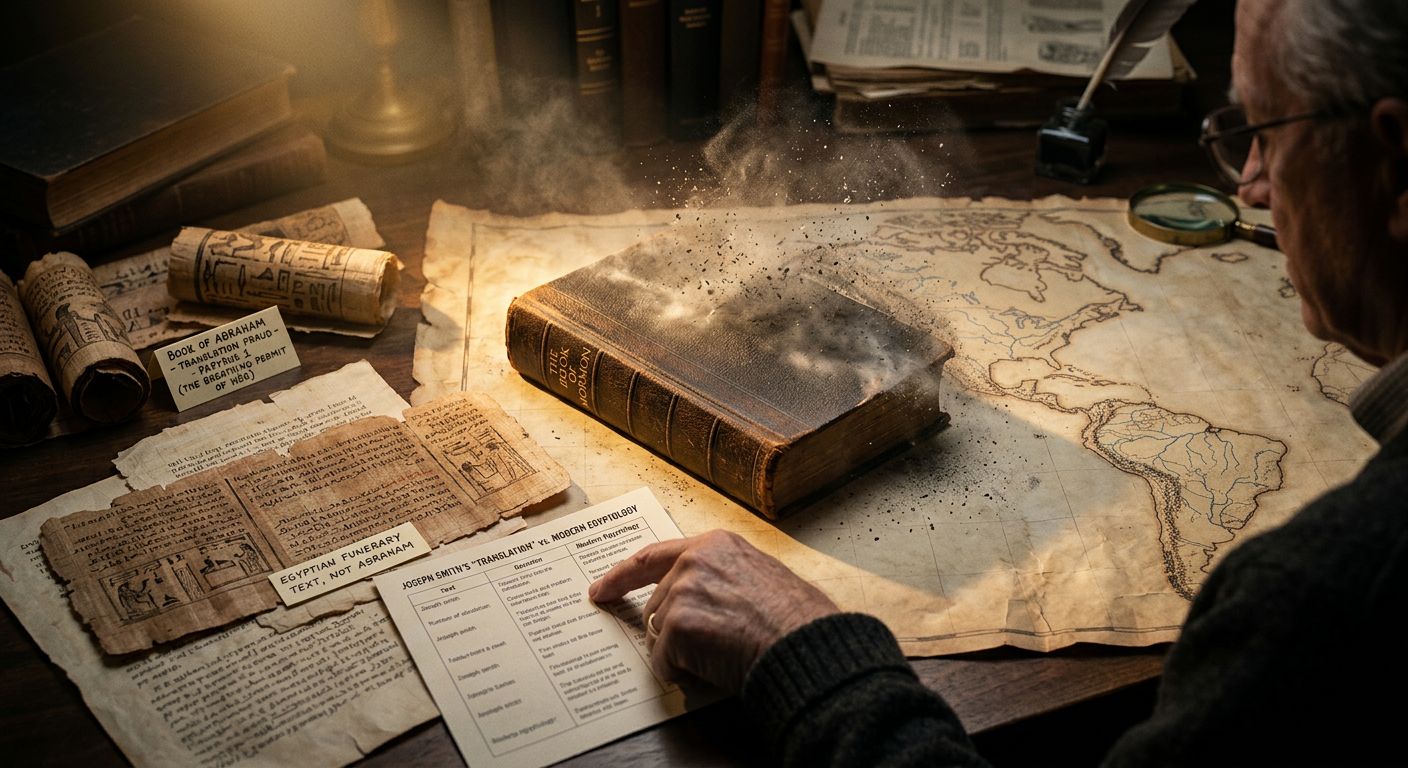
The Book of Mormon describes advanced civilizations, horses, steel, wheat, and elephants in pre-Columbian America — none confirmed by archaeology, genetics, or linguistics. The Smithsonian Institution has officially stated the Book of Mormon is not used as a scientific guide. Joseph Smith's 'translation' of the Book of Abraham from Egyptian papyri was proven fraudulent when Egyptologists translated the actual source — it was a common funerary text (Book of Breathings). Mormon theology teaches polytheism ('as man is, God once was; as God is, man may become') contradicting Isaiah 43:10 and 44:6. Temple rituals borrowed heavily from Freemasonry after Smith became a Mason in 1842.
Read the full examination: What the Church Itself Now ConcedesFounded
1830 CE
Founder
Joseph Smith Jr.
Adherents
17 million
Sources Cited
18+
Error-by-Error Analysis
Click each error to expand the full analysis with primary sources and scripture evidence.
All 13 Gospel Topics essays are now in ReProof's library
What the Church Itself Now Concedes
Between 2013 and 2015 the Church of Jesus Christ of Latter-day Saints published a series of essays acknowledging facts that members had been told for decades were anti-Mormon invention. This is a timeline of the origin — argued, wherever possible, from those essays and from Joseph Smith's own documents.
Three questions, answered directly
Is there one account of the First Vision?
No. There are at least four accounts written or dictated by Joseph Smith, plus others recorded by contemporaries, and they differ on material points — including who appeared. The earliest, written in his own hand in 1832, describes the Lord alone; the 1838 version, the one members memorise, describes two personages. The Church's own essay acknowledges the multiple accounts and the differences.
Do the Book of Abraham papyri say anything about Abraham?
No. The papyri were recovered in 1966 and can be read by any Egyptologist. They are ordinary funerary documents — a Book of Breathings and a Book of the Dead. The Church's essay concedes that none of the characters on the surviving fragments mention Abraham or any event in the Book of Abraham.
What does the Church concede about the marriages?
That the youngest woman sealed to Joseph Smith was Helen Mar Kimball, sealed to him several months before her fifteenth birthday, and that he was sealed to a number of women who were already married to living men. Both statements are quoted word for word from the Church's own essay on plural marriage in Kirtland and Nauvoo. We deliberately put no total number on the marriages — see the note below.
Origin — the accounts and the plates
The question is not whether Joseph Smith was sincere. It is whether the account of the origin has stayed the same, and whether the book can be what it says it is.
The first written account of the visionNot held
Smith's earliest account, partly in his own handwriting, describes a single divine figure and frames the experience around forgiveness of his sins. It says nothing about being told all churches were false by two personages.
The 1838 account — canonised as Joseph Smith–History and taught in every ward — describes the Father and the Son appearing together and condemning all existing creeds. Both are Smith's. They are not the same story.
How the translation was actually doneIn corpus
For most of the twentieth century members pictured Smith reading the plates behind a curtain. The Church's own essay describes the method attested by those present: a seer stone placed in a hat, the face pressed into the hat to exclude light, and the plates frequently not in the room at all.
Joseph Smith and his scribes wrote of two instruments used in translating the Book of Mormon… the Prophet also used a seer stone… he placed the seer stone in a hat, pressed his face into the hat to block out extraneous light.
“Book of Mormon Translation,” LDS Gospel Topics essay · lds://gospel-topics/book-of-mormon-translation
This matters less as ridicule than as evidence about the kind of claim being made. If the plates were not needed in the room, their role in the story changes considerably.
The witnesses — and why they are the strongest thing hereNot held
Eleven men signed statements about the plates, and their testimony is still printed in the front of every copy. Three of them later left the Church in bitter circumstances. None of the eleven is known to have retracted. Anyone arguing this subject who does not know that is not ready to argue it.
The hinge — a document that can be checked
Every other question here turns on testimony. This one does not. The source material survives, and it is in a language scholars read fluently.
Papyri bought from a travelling exhibitorNot held
Smith purchases Egyptian papyri and mummies from Michael Chandler and announces that they contain the writings of Abraham. He produces a translation, published as the Book of Abraham and canonised in the Pearl of Great Price, complete with facsimiles and his explanations of the figures in them.
The papyri are rediscovered — and readNot held
Fragments long thought lost in the Chicago fire turn up in the Metropolitan Museum of Art. Egyptology by then is a mature discipline. The fragments are identified as a Book of Breathings and associated funerary texts, of a common type, dating roughly to the Ptolemaic or early Roman period — over a thousand years after Abraham.
The facsimile explanations can also be checked against standard Egyptological readings of the same scenes, and they do not match.
The Church concedes the point in printIn corpus
The Gospel Topics essay does not dispute the Egyptology. It relocates the claim — arguing that the papyri may have been a catalyst for revelation rather than the source of a literal translation.
None of the characters on the papyrus fragments mentioned Abraham's name or any of the events recorded in the book of Abraham.
“Translation and Historicity of the Book of Abraham,” LDS Gospel Topics essay · lds://gospel-topics/translation-and-historicity-of-the-book-of-abraham
This is the load-bearing item in the whole case, because it is the one testable translation Joseph Smith left behind. The Book of Mormon plates are unavailable by definition. The papyri are in a museum. Where his translating could be checked, it did not hold — and the Church has now said so itself, in its own words, on its own website.
Doctrine and practice, dated
Freemasonry and the endowment, seven weeks apartNot held
Joseph Smith was initiated as a Freemason in March 1842 and introduced the temple endowment in May 1842. The two ceremonies share signs, tokens, penalties and phrasing; the resemblance is acknowledged by LDS historians, who explain it as inspired restoration using familiar forms.
We state the chronology because it is documented, and we leave the explanation contested. It is evidence, not proof of fraud.
Plural marriage: instituted, denied, then ended by revelationIn corpus
Practised privately from the early 1840s while being publicly denied, announced openly by Brigham Young in 1852, and ended by the Manifesto of 1890 under federal pressure that threatened the Church's property and Utah's statehood.
The youngest was Helen Mar Kimball, daughter of Joseph's close friends Heber C. and Vilate Murray Kimball, who was sealed to Joseph several months before her 15th birthday.
Following his marriage to Louisa Beaman and before he married other single women, Joseph Smith was sealed to a number of women who were already married.
“Plural Marriage in Kirtland and Nauvoo,” LDS Gospel Topics essay · lds://gospel-topics/plural-marriage-in-kirtland-and-nauvoo
Both sentences are the Church's own, quoted exactly. We do not put a total number on the marriages, because the essay's own text does not give one — the commonly cited figure of thirty to forty comes from historians' tallies rather than from this essay, and attaching it to the essay is an error we have made ourselves and corrected.
The priesthood ban, and its disavowalNot held
Black members were barred from the priesthood and the temple from the mid-nineteenth century until 1978. Church leaders taught doctrinal justifications for the ban during that period. In 2013 the Church published an essay disavowing those explanations outright — including the theories that black skin was a curse or a sign of less valiance in a pre-mortal life.
That disavowal is genuinely creditable. It also raises the question this page keeps returning to: if prophets taught those explanations as doctrine for over a century, what is the standing of what prophets teach today?
The historical claim, and the evidence for it
DNA and the origin of Native AmericansIn corpus
The Book of Mormon presents its peoples as Israelite migrants who became a principal ancestral population of the Americas. Population genetics places Native American origins overwhelmingly in Asia.
The evidence assembled to date suggests that the majority of Native Americans carry largely Asian DNA.
“Book of Mormon and DNA Studies,” LDS Gospel Topics essay · lds://gospel-topics/book-of-mormon-and-dna-studies
The essay's response is a limited-geography model — a small group whose genetic signal would be swamped. That is a serious reply. It is also a substantial retreat from how the book was understood for a century and a half.
Objects in the text that are not in the groundNot held
The Book of Mormon describes horses, chariots, steel swords, silk and wheat in the pre-Columbian Americas. None of these is attested archaeologically for the relevant period and region. No named city, king, battle or inscription from the book has been located.
A caution against the sloppy version of this argument: barley is often included in such lists, and should not be — domesticated barley has been identified at pre-Columbian sites in North America since 1983. Using a refuted item hands the whole list away.
What members were told, and what the Church now says
The left column is what was commonly taught in wards and seminaries. The right column is the Church's own published position since 2013.
| Long taught | Conceded in the Gospel Topics essays |
|---|---|
| One consistent First Vision account | Multiple accounts exist, written across two decades, differing on who appeared and why |
| The plates were translated by the Urim and Thummim, plates in view | A seer stone in a hat, face pressed in to block the light; the plates often not present |
| The Book of Abraham is a translation of the papyri | The surviving fragments mention neither Abraham nor any event in the book |
| Joseph Smith had one wife, or a few, for the widows' sake | A girl sealed to him months before her fifteenth birthday, and sealings to women already married to living men |
| Native Americans are principally descended from Lehi's family | The majority of Native Americans carry largely Asian DNA |
| The priesthood ban had a doctrinal basis taught by prophets | Those explanations are disavowed by the Church |
Claims we do not make
This case is made almost entirely from the Church's own publications. Everything below is unnecessary, and each item is a gift to the other side.
| The claim | Why we refuse it |
|---|---|
| Mocking temple garments, the endowment, or the ceremonies. | It is contemptuous of something people hold sacred, and it converts an argument about the Book of Abraham into an argument about our manners. We lose that one. |
| “Mormons are not Christians.” | Used as a slur it teaches nothing. There is a real and serious doctrinal difference — on the nature of God, on eternal progression, on whether God was once a man — and stating that difference precisely is far more useful than a label. |
| “Joseph Smith was a con man from the beginning.” | Motive cannot be documented, and the claim is unnecessary. The Book of Abraham papyri do the work without any theory about what was in his heart. |
| “Mormons practise polygamy.” | The LDS Church ended it in 1890 and excommunicates those who practise it. Confusing the LDS Church with fundamentalist splinter groups is a factual error that a member will correct instantly, and rightly. |
| “Masonry proves the temple ritual is fraudulent.” | The chronology of 1842 is documented and we state it. The inference is not proof — borrowing familiar ritual forms is what religious movements do, and LDS scholars answer it in exactly those terms. |
| Sensationalised accounts of Smith's marriages. | The Church's own essay is more damaging than any anti-Mormon pamphlet, because it cannot be dismissed. Quote the essay. Never embellish it. |
Mormonism rests on one man's claim to have translated ancient records by divine power. There is exactly one case where that claim can be tested, and it has been tested. The Book of Abraham papyri were recovered in 1966, they are ordinary Egyptian funerary texts, and the Church now acknowledges in print that they contain nothing about Abraham. Where the translating could be checked, it did not hold.
Around that centre stand a series of facts that the Church itself has now published: multiple and materially different accounts of the founding vision, a translation method quite unlike what members were taught, sealings to a girl not yet fifteen and to women already married to living men, a genetic record that does not support the book's account of the Americas, and a century-long racial policy whose doctrinal justifications the Church has disavowed.
That the Church published these essays is to its credit and we say so. But publishing them changes the question. It is no longer whether the facts are true — that is settled by the Church's own website. It is what a movement should conclude when its founding claims are conceded piece by piece.
The strongest counters to our position
- The essays are evidence of honesty, not concealment. An institution that publishes the hardest facts about its own founder on its own website is doing something most religious bodies never do, and it deserves to be said plainly.
- No witness ever recanted. Eleven men signed, three of them left the Church acrimoniously, and none took back the testimony. Ordinary fraud does not usually behave that way, and this is the single strongest argument on the LDS side.
- The book is more sophisticated than the theory of its production allows. The chiastic structure of passages such as Alma 36, and the internal consistency of a long and complex narrative dictated in roughly three months by a man of little formal education, is a real problem for any simple account of composition.
- The fruits argument has weight. Family stability, welfare provision, disaster relief and community care within the LDS Church are, by ordinary measures, impressive. “By their fruits you shall know them” is a test we chose, and it does not return a simple verdict here.
Key Scriptures
Ready to Debunk Mormonism (LDS)?
Enoch is armed with 1,800,000+ sources — ask any question about Mormonism (LDS) and get scholarly rebuttals instantly.