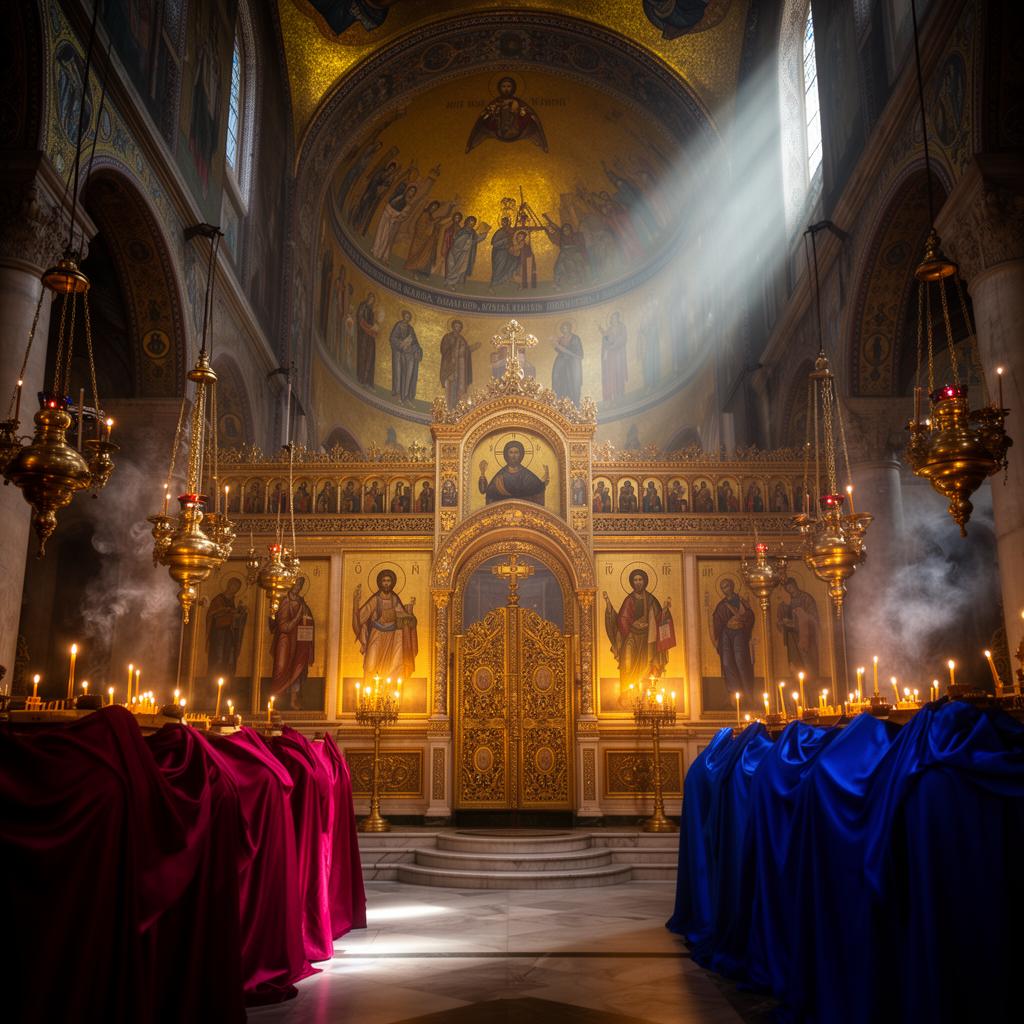
Eastern & Oriental OrthodoxyExposed
Eastern Orthodoxy split from Rome in 1054 over the Filioque and papal supremacy, while the Oriental Orthodox churches (Coptic, Armenian, Ethiopian, Syriac) split earlier at Chalcedon (451 CE) over the nature of Christ. Both branches preserved much of the early patristic witness — but layered onto Scripture a binding 'Sacred Tradition' (Seven Ecumenical Councils, liturgy, icons, Fathers) that Yeshua and the apostles never endorsed (Mark 7:7-8). Icon veneration (defined dogmatically at Nicaea II, 787 CE) violates the Second Commandment (Exodus 20:4-5) regardless of the proskynesis/latreia distinction. Marian titles — Theotokos, Ever-Virgin, intercessor — exceed every NT description of Miriam. The doctrine of theosis ('God became man so that man might become god') borrows language no apostle ever used of believers becoming partakers of the divine essence. The Oriental churches additionally reject the two-natures formula of Chalcedon, producing centuries of christological confusion.
Read the full examination: When the Icons Were DecidedFounded
1054 CE (Great Schism) / 451 CE (Chalcedon split)
Founder
Byzantine Patriarchate / non-Chalcedonian bishops
Adherents
260 million (220M Eastern + 60M Oriental)
Sources Cited
29+
Error-by-Error Analysis
Click each error to expand the full analysis with primary sources and scripture evidence.
One practice, traced through the councils that ruled on it
When the Icons Were Decided
Orthodoxy's claim is continuity: the faith of the apostles, unaltered, while everyone else innovated. This is a timeline of one practice at the centre of Orthodox life — the veneration of images — showing when it was ruled on, who opposed it, and what had to be settled by council rather than inherited.
Three questions, answered directly
When was icon veneration made binding?
At the Second Council of Nicaea in 787 — over seven centuries after the apostles, and after a council of 338 bishops at Hieria had condemned the practice thirty-three years earlier. Whatever conclusion one reaches, this is not a matter that was simply handed down undisturbed. It was fought over for more than a century and settled by imperial and conciliar force.
Did the early Church have images in churches?
The earliest surviving conciliar ruling on the question forbids them. Canon 36 of the Council of Elvira, around 305, directs that pictures ought not to be in churches. Eusebius, writing to the emperor's sister a few decades later, refused to supply an image of Christ and treated the request as improper.
Did Orthodoxy add a pope, purgatory, or infallibility?
No — and this deserves to be said plainly on a page that is otherwise critical. Orthodoxy never developed the papal claims of 1075 and 1870, never defined purgatory, never sold indulgences, and never made a bishop personally infallible. Where our disagreement with Rome is about a monarchy, our disagreement here is narrower and more specific.
Before the icons — an aniconic beginning
The evidence for the earliest period is thin on all sides, and we should say so. But the earliest explicit rulings that survive go the other way from later practice.
The Council of Elvira forbids pictures in churchesNot held
A Spanish council, early in the fourth century, gives the earliest surviving conciliar ruling on the subject. Its reasoning is precisely the second-commandment concern.
Pictures ought not to be in a church, lest that which is worshipped and adored should be painted on the walls.
Council of Elvira, Canon 36
The honest qualification: Elvira was a small regional council, its canons were not universally received, and the canon is sometimes read as a practical measure during persecution rather than a doctrinal one. But it is what the earliest ruling says, and it says the opposite of what was later defined.
Eusebius refuses to send an image of ChristNot held
Constantia, the emperor's sister, asked the bishop of Caesarea for an image of Christ. His reply treats the request as misconceived — that the glorified Messiah cannot be captured in dead colours, and that what she is asking for is closer to the practice of the nations than of the Church.
Eusebius is not an obscure figure. He is the Church's first historian and a bishop close to the imperial family, and his instinct in the 330s was that this was not done.
The hinge — a century of conflict, and two councils that disagree
This is the part of the story that matters most, because it is not a story of quiet continuity. It is a story of Christians on both sides anathematising each other for over a hundred years.
A council of 338 bishops condemns the imagesNot held
The Council of Hieria, convened by Constantine V, ruled against the making and veneration of icons. It was larger than several councils now accepted as ecumenical, it understood itself to be ecumenical, and it condemned icon veneration as a return to idolatry.
It was later annulled. But its existence establishes something no amount of later definition can erase: in the eighth century, a very large body of Eastern bishops believed icon veneration was idolatry. This was an internal Christian dispute, not a Protestant objection invented eight hundred years later.
Second Nicaea reverses it, and draws the distinctionNot held
The council that Orthodoxy counts as the seventh ecumenical council restores the images — and, crucially, defines the difference on which the whole practice depends.
…to these should be given due salutation and honourable reverence, not indeed that true worship of faith which pertains alone to the divine nature… for the honour which is paid to the image passes on to that which the image represents.
Second Council of Nicaea (787), Definition
The distinction between veneration and worship is real, it is carefully drawn, and any critic who ignores it is arguing with a position no Orthodox Christian holds. Our objection is not that the distinction is dishonest. It is that it was defined into existence to license a practice a previous council had condemned, and that a distinction this fine is unlikely to survive contact with ordinary devotion.
The Triumph of OrthodoxyNot held
After a second iconoclast period, the images are restored permanently under the Empress Theodora, and the event is commemorated annually on the first Sunday of Lent. The name given to that commemoration — the Triumph of Orthodoxy — makes the point better than we can: the identity of Orthodoxy is dated, in its own calendar, to the winning of this argument in the ninth century.
What Scripture actually forbids — and what it does not
The crude iconoclast argument is wrong, and we should dispose of it before making the real one.
The commandIn corpus
The text is specific about what is forbidden, and about what the forbidden thing is for.
Thou shalt not make unto thee a graven image, nor any likeness of any thing that is in heaven above, or that is in the earth beneath, or that is in the water under the earth: thou shalt not bow down thyself unto them, nor serve them; for I Jehovah thy God am a jealous God.
Exodus 20:4–5 (ASV) · bible://asv/exodus/20:4
And the images God commandedIn corpus
The Orthodox reply here is strong and we should concede it immediately. God commanded cherubim of gold on the ark, cherubim woven into the veil, a bronze serpent lifted on a pole for the healing of Israel, twelve oxen under Solomon's sea and lions on his throne. A reading of the second commandment that forbids all religious imagery is refuted by the tabernacle itself.
So the commandment cannot mean no images. It means no images made for bowing to and serving. That narrows the argument — and it is the narrowed argument we make.
The bronze serpent, and what happened to itIn corpus
The sharpest case in Scripture is an object God himself commanded. Centuries later, Hezekiah destroyed it — because the people had begun to burn incense to it.
A God-given image, made at divine command, through which God had healed, was destroyed by a righteous king when it became an object of devotion. That is the pattern we think applies. Not that images are inherently forbidden, but that the trajectory from honour to devotion is a documented one, and that Scripture treats it as requiring action rather than definition.
The wider structure
Theotokos defined at EphesusNot held
The title Theotokos — God-bearer — was defined to protect a claim about Christ, not to elevate Mary: if Mary bore God, then the one she bore is God. Understood in those terms it is a christological statement, and we do not dispute the christology.
What followed is a different question. The feasts, the hymnography, the Dormition, and a devotional life in which Mary is addressed constantly are not contained in the 431 definition, and did not arrive with it.
Chalcedon divides the East permanentlyNot held
The Oriental Orthodox churches — Coptic, Armenian, Syriac, Ethiopian — did not receive Chalcedon, and were called monophysite for fifteen hundred years.
That charge is now largely withdrawn. Joint theological commissions in the twentieth century concluded that the difference was substantially about terminology rather than about the reality of Christ's divinity and humanity. Anyone still using “monophysite heretics” of the Copts is repeating an accusation that both sides have retired.
Tradition as an authority that cannot be testedNot held
Orthodoxy holds Scripture within Holy Tradition rather than over it — Scripture is the Church's book, read in the Church's liturgy, interpreted by the Church's mind. There is real force in this: it accounts for the canon, which sola scriptura struggles to do.
But it produces the same closure Trent produced in the West. If Tradition is the authority by which Scripture is read, no development within Tradition can be tested by Scripture and found wanting. The practice defined in 787 becomes unreviewable, and the reason a council was needed at all disappears from view.
Where we agree, and where we do not
Orthodoxy holds a great deal that we hold, and this table should be read before the criticism.
| Question | Orthodox position | Ours |
|---|---|---|
| No papacy, no infallible bishop | Authority is conciliar; primacy is honour, not jurisdiction | We agree, and the historical case is on their side against Rome |
| No purgatory or indulgences | Never defined; never sold | We agree — these are Western developments |
| Continuity of liturgy | The rite is ancient and largely unbroken | Genuinely true, and more than most Protestants realise |
| Theosis | The believer is made a partaker of the divine nature | The language is biblical (2 Peter 1:4). We part company where participation is spoken of as becoming god by grace — not because the fathers meant idolatry, but because the phrase now misleads |
| Icon veneration | Defined at Nicaea II; honour passes to the prototype | We disagree. Condemned at Elvira, condemned by 338 bishops at Hieria, defined into legitimacy in 787 — and Hezekiah's response to the bronze serpent is the pattern we follow |
| Marian devotion | Theotokos, the Dormition, constant liturgical address | We accept the christological definition of 431 and not the devotional structure built after it |
| Scripture and Tradition | Scripture within Tradition | We disagree — an authority that cannot be tested by Scripture cannot be corrected by it either |
Claims we do not make
Almost all popular Protestant criticism of Orthodoxy is aimed at a position no Orthodox Christian holds. These are refused.
| The claim | Why we refuse it |
|---|---|
| “Orthodox Christians worship idols.” | The council that authorised the practice explicitly denied it, in the very definition, and drew the distinction in terms. Ignoring that means arguing with nobody. Our case is about the history of the practice and about where devotion drifts, not about a charge the tradition already answered in 787. |
| “The Oriental Orthodox are monophysite heretics.” | Out of date by decades. Joint commissions concluded the ancient dispute was largely terminological. Repeating a fifteen-hundred-year-old slur that both sides have withdrawn tells an Orthodox reader we have not done the reading. |
| “The second commandment forbids all religious images.” | Refuted by the ark's cherubim, the bronze serpent and Solomon's temple — all commanded or approved. The crude version of this argument loses to an Orthodox deacon in about ten seconds, and takes the good version down with it. |
| Mocking incense, vestments, chant or liturgy. | The tabernacle had incense and vestments by divine command. We of all people cannot object to liturgical form as such. |
| “Constantine invented Orthodoxy.” | False, and it undercuts our own better argument. Elvira was ruling on images before Constantine's council, and the iconoclast controversy was fought four centuries after him. |
| “Orthodox Christians are not saved.” | Not ours to say, of a communion that has confessed the incarnation and resurrection continuously for two millennia and produced martyrs in living memory under Soviet rule. |
Orthodoxy's claim to continuity is stronger than Rome's, and we say so without reservation. It did not build a monarchy, it did not define purgatory, it did not make a man infallible, and its liturgy really is ancient. Where the argument on the Roman page is about an office that grew, the argument here is narrower.
Our objection is that the central devotional practice of Orthodox life was decided, not inherited. The earliest surviving conciliar ruling forbade pictures in churches. The Church's first historian declined to supply an image of Christ. Three hundred and thirty-eight bishops condemned the practice as idolatry in 754. It was restored in 787 by a definition that had to invent a careful distinction between two kinds of reverence in order to license it, and secured by imperial power in 843 — an event Orthodoxy still commemorates annually under the name of its own identity.
A practice requiring a century of conflict, two reversals and a new technical distinction to establish is not the untouched deposit of the apostles. It may still be right — councils can settle things correctly. But it cannot be defended on the ground that it was never in question, because for a hundred and twenty years it was the question.
The strongest counters to our position
- The incarnation argument is serious. John of Damascus's case is that God became visible and touchable, and that refusing to depict the incarnate Son quietly denies the flesh he took. That is a theological argument, not sentiment, and it has never been comfortably answered by iconoclasts of any century.
- God commanded images. Cherubim on the ark, in the very room where he met Israel; a bronze serpent to be looked at for healing. Any argument from the second commandment must survive that, and the crude version does not.
- Orthodoxy did not do what Rome did. No papacy, no indulgences, no purgatory, no infallibility, no Inquisition. If our historical method condemns accretion, Orthodoxy has markedly less of it to answer for, and consistency requires saying so.
- Someone recognised the canon. The list of New Testament books came to us through the Church's reading and use, not from a verse. Orthodoxy's account of Scripture within Tradition explains that straightforwardly, and our account has more work to do than we usually admit.
Ready to Debunk Eastern & Oriental Orthodoxy?
Enoch is armed with 1,800,000+ sources — ask any question about Eastern & Oriental Orthodoxy and get scholarly rebuttals instantly.